Primary Keyword: cash flow vs profit service business
Meta Description: 33% of service business owners struggle with cash flow issues. Learn the critical difference between cash flow and profit, and why confusing them is costing you money.
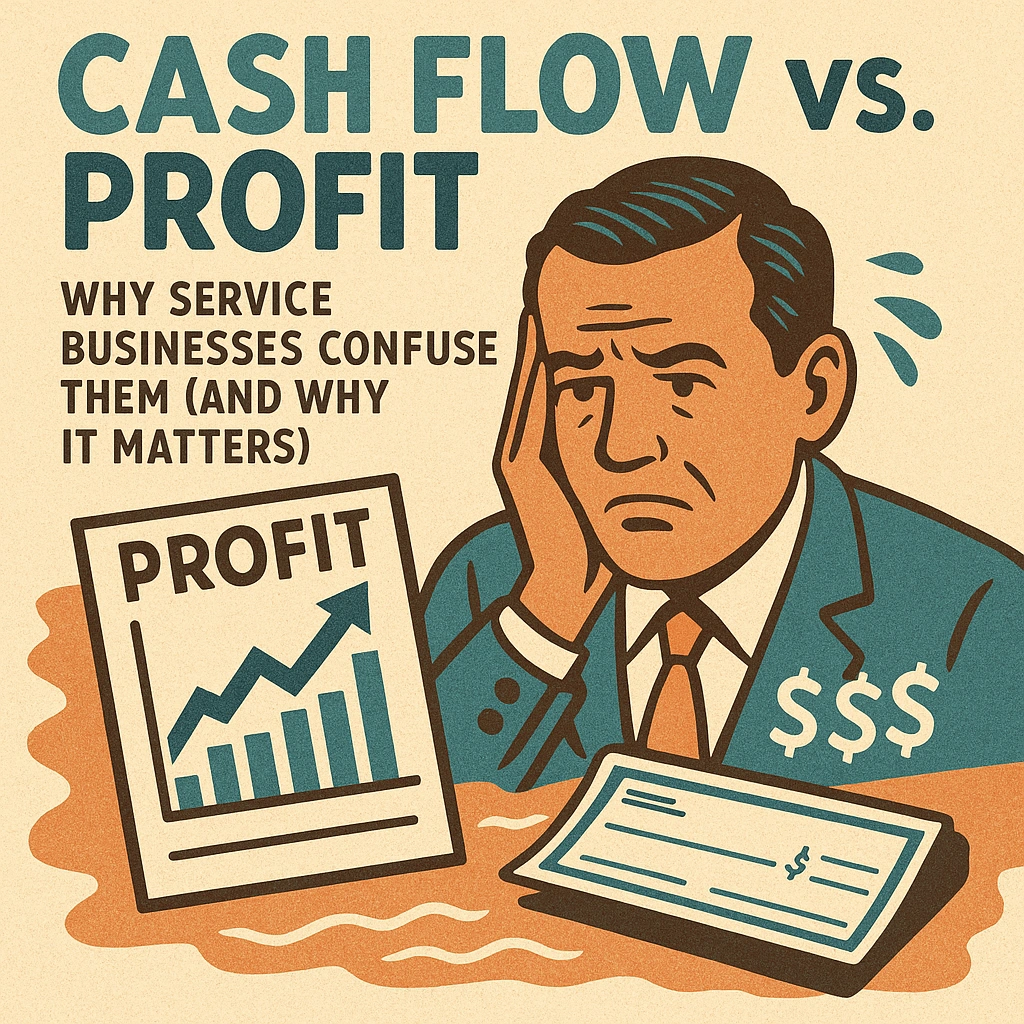
Cash Flow vs. Profit: Why Service Businesses Confuse Them (And Why It Matters)
Your business is profitable on paper. So why can’t you make payroll next week?
Marcus had every reason to believe his consulting firm was doing well.
His accountant sent him quarterly financials showing healthy profit margins. His revenue was up year over year. He’d closed several large projects. The numbers looked great.
Then his largest client delayed payment by 60 days, and suddenly he couldn’t cover payroll without draining his personal savings.
“How can I be profitable but broke?” he asked his accountant, frustrated and confused.
The answer: because understanding cash flow vs profit in a service business is critical, and confusing them is one of the most expensive mistakes you can make.
The Confusion That Costs Service Businesses Thousands
According to recent research, cash flow problems affect one in three service business owners. It’s the most commonly cited financial challenge—more than pricing, more than client acquisition, more than competition.
But here’s what makes it particularly dangerous: many of these cash-strapped business owners are actually profitable.
They have positive net income on their profit and loss statement. Their margins look acceptable. Their business appears healthy.
Until they can’t pay their bills.
This disconnect happens because most service business owners make decisions based on profit without understanding cash flow. They look at their bank account when they should be looking at their cash flow forecast. They celebrate revenue without tracking collections.
The result? Profitable businesses that run out of money.
What Profit Actually Tells You
Let’s start with the basics.
Profit is an accounting concept. It’s what’s left after you subtract all your expenses from your revenue over a specific period.
Revenue minus Costs equals Profit.
It appears on your income statement. It tells you whether your business model works. It shows whether you’re charging enough and controlling costs effectively.
Profit is essential. It’s the scorecard for your business viability.
But profit is measured on an accrual basis. That means revenue is counted when you earn it, not when you receive payment. Expenses are counted when you incur them, not when you pay the bill.
This creates a fundamental disconnect between profit and cash.
Marcus booked a large consulting project in March. His accountant recorded the revenue in March. His profit and loss statement for Q1 looked excellent.
But his payment terms were net 60. The client didn’t pay until May. And when they delayed an additional month, Marcus didn’t see the cash until June.
On paper, he was profitable in Q1. In reality, he had no cash to operate.
What Cash Flow Actually Tells You
Cash flow is different. It’s not an accounting concept—it’s a survival metric.
Cash flow measures the actual movement of money in and out of your business. When cash comes in from clients, when cash goes out to pay expenses, when money is tied up in unbilled work or outstanding invoices.
Positive cash flow means more money came in than went out during a specific period. Negative cash flow means the opposite.
You can have profit with negative cash flow. You can have losses with positive cash flow.
Service businesses live and die by cash flow, not profit. Because while you can be profitable on paper, you can’t pay your team, your rent, or your vendors with accounting entries.
You need actual cash.
The Four Ways Service Businesses Create Cash Flow Problems
Most cash flow problems in service businesses come from four patterns. Often, businesses suffer from more than one simultaneously.
Pattern 1: Long Payment Terms Without Cash Reserves
Service businesses often extend generous payment terms to win or keep clients. Net 30, net 45, sometimes net 60 or longer.
This means you deliver the work today and wait weeks or months to get paid.
Meanwhile, you still have to pay your team, your software subscriptions, your rent, your contractors. Those expenses don’t wait.
The gap between delivering work and receiving payment creates a cash flow deficit. If you don’t have cash reserves to bridge that gap, you’re in trouble the moment a client delays payment or a large invoice comes due.
Marcus’s firm had consistent profit margins but operated with minimal cash reserves. One delayed payment created an immediate crisis.
Pattern 2: Growth That Outpaces Cash
This sounds counterintuitive, but rapid growth often creates cash flow problems for service businesses.
Here’s why: when you sign new clients, you typically need to deliver work before you get paid. You might need to hire additional team members or contractors. You might need to invest in new tools or systems.
All of that requires cash upfront. The revenue shows up later.
The faster you grow, the more cash you need to fund that growth. If your growth rate exceeds your cash generation rate, you create a dangerous gap.
Many service businesses have grown themselves into insolvency—not because they weren’t profitable, but because they ran out of cash before their growth became self-sustaining.
Pattern 3: Scope Creep and Unbilled Hours
This is where service businesses quietly bleed cash.
You agree to a project scope. Somewhere along the way, the client asks for a few additional changes. Nothing major. You accommodate because you want to maintain the relationship.
Then a few more changes. A few more hours. Some additional revisions that fall into a gray area between in-scope and out-of-scope.
Suddenly you’ve delivered far more than you were paid for. Those extra hours consumed cash—team time, your time, possibly contractor costs. But you didn’t bill for them, so no cash comes back in.
This happens silently, project by project. You look at your profit and loss statement and see decent margins. But your cash flow tells a different story—you’re working for free more often than you realize.
Pattern 4: Poor Visibility Into Cash Timing
Most service business owners have a general sense of their bank balance. Few have a clear view of their cash flow timing.
They don’t know:
- Exactly when outstanding invoices will be paid
- How much cash will be required over the next 30, 60, 90 days
- Whether they have enough runway to cover planned expenses
- Which months will be tight and which will be comfortable
Without this visibility, they make decisions reactively. They discover cash shortfalls when it’s too late to prevent them.
Marcus had no cash flow forecast. He knew he had invoices outstanding but didn’t track payment patterns or project future cash needs. When multiple clients paid late simultaneously, he was caught completely off guard.
The Dangerous Decisions Made When You Can’t See the Difference
When business owners confuse profit with cash flow, they make decisions that feel right but create problems.
Decision 1: Taking on unprofitable growth
“We’re growing, so we must be doing well.” Not necessarily. If that growth is draining cash faster than it generates profit, you’re building a house of cards.
Decision 2: Underinvesting in cash reserves
“We’re profitable, so we don’t need a big cash cushion.” Until you do. Cash reserves aren’t a luxury—they’re insurance against timing mismatches and client payment delays.
Decision 3: Ignoring collection problems
“Our revenue is good, so late payments aren’t urgent.” Late payments destroy cash flow. Every day an invoice remains outstanding is a day you’re funding your client’s operations with your cash.
Decision 4: Making hiring decisions based on profit, not cash
“Our margins support another hire.” But can you afford the cash outlay before that hire generates billable revenue? Many service businesses hire based on profit projections and then struggle to make payroll.
What to Track: The Numbers That Actually Matter
Understanding cash flow vs profit in service business contexts means tracking both—but tracking them differently and understanding what each metric tells you about your operations.
For Profit, Track:
- Gross profit margin by service line
- Net profit margin overall
- Revenue per client
- Cost per project
- Operating expense ratio
These tell you whether your business model is sustainable and where you’re most profitable.
For Cash Flow, Track:
- Days sales outstanding (how long it takes to collect payment)
- Cash runway (how many months you can operate without new revenue)
- Weekly cash position
- Accounts receivable aging (which invoices are overdue)
- Cash conversion cycle (time from starting work to receiving payment)
These tell you whether you can keep the lights on and where your cash is tied up.
Both matter. But for day-to-day survival, cash flow matters more.
The Simple Framework: When to Focus on What
Here’s a practical way to think about the difference:
Focus on profit when making strategic decisions:
- Should we launch this new service line?
- Is this client segment worth pursuing?
- Are our prices adequate?
- Which services should we expand or eliminate?
Profit tells you what’s worth doing.
Focus on cash flow when making operational decisions:
- Can we afford to hire this person now?
- Should we invest in this tool this month?
- Do we need to tighten payment terms?
- How aggressively should we pursue collections?
Cash flow tells you what you can afford to do right now.
Monitor both weekly:
Every week, look at your profit and loss statement to understand business health. And look at your cash flow statement to understand operational reality.
When profit is strong but cash is tight, you have a timing or collections problem. Fix payment terms, accelerate collections, or build reserves.
When cash is strong but profit is weak, you have a pricing or cost problem. You’re getting paid, but your business model isn’t sustainable.
Both scenarios require action. But they require different actions.
How Service Businesses Can Bridge the Gap
The good news: once you understand the relationship between cash flow vs profit in your service business, you can take specific steps to manage both effectively.
For immediate cash flow relief:
- Tighten payment terms on new contracts (move from net 30 to net 15, or require deposits)
- Invoice more frequently (weekly or biweekly instead of monthly)
- Follow up on overdue invoices within 24 hours of the due date
- Offer small discounts for early payment
- Build payment milestones into large projects (collect portion upfront, portion at midpoint, portion on completion)
For long-term cash flow health:
- Build 3-6 months of operating expenses in cash reserves
- Create a 13-week rolling cash flow forecast
- Track collection patterns by client to identify slow payers early
- Shift toward retainer models that provide predictable monthly cash
- Stop accommodating scope creep—bill for extra work or politely decline
For profit improvement:
- Analyze profitability by client and service line
- Eliminate or restructure unprofitable offerings
- Optimize pricing based on value delivered
- Reduce delivery costs through process improvements
- Increase team utilization rates
These aren’t either-or choices. Strong service businesses manage both profit and cash flow systematically.
Why Financial Visibility Changes Everything
Marcus eventually solved his cash flow crisis. But the real breakthrough came when he implemented weekly cash flow tracking and a 90-day forecast.
He could finally see the gaps before they became emergencies. He knew which months would be tight and could plan accordingly. He identified clients with chronic late payment patterns and adjusted terms.
Most importantly, he stopped making decisions based on incomplete information.
His business was always profitable. Now it finally had the cash flow to match.
Financial visibility doesn’t just prevent crises. It enables better decisions, reduces stress, and creates confidence in your business operations.
When you can see both profit and cash flow clearly, you’re no longer reacting to surprises. You’re managing your business strategically.
The Path Forward
If you’ve ever wondered how you can be profitable but still struggle to pay bills, you’re not alone. The confusion around cash flow vs profit in service business operations affects thousands of business owners.
The solution isn’t complicated, but it requires discipline:
- Track both profit and cash flow separately
- Understand which metric informs which decisions
- Build systems that give you visibility into both
- Take action on the insights before they become problems
Your business doesn’t need to choose between profitability and cash flow. You need both. And understanding the difference is the first step to having both.
Join the first 50 business owners on our launch list and receive a free Lite Profitability Roadmap ($295 value).
Profit tells you if your business works. Cash flow tells you if your business survives. You need both.
Recent Comments
Recent Comments
Archives
Categories
Profit Lab Score™ your partner to discover lost profitability in your business!
Copyright © 2026 Profit Lab Score™

Profit Lab Score™ your partner to discover lost profitability in your business!
Copyright © 2026 Profit Lab Score™