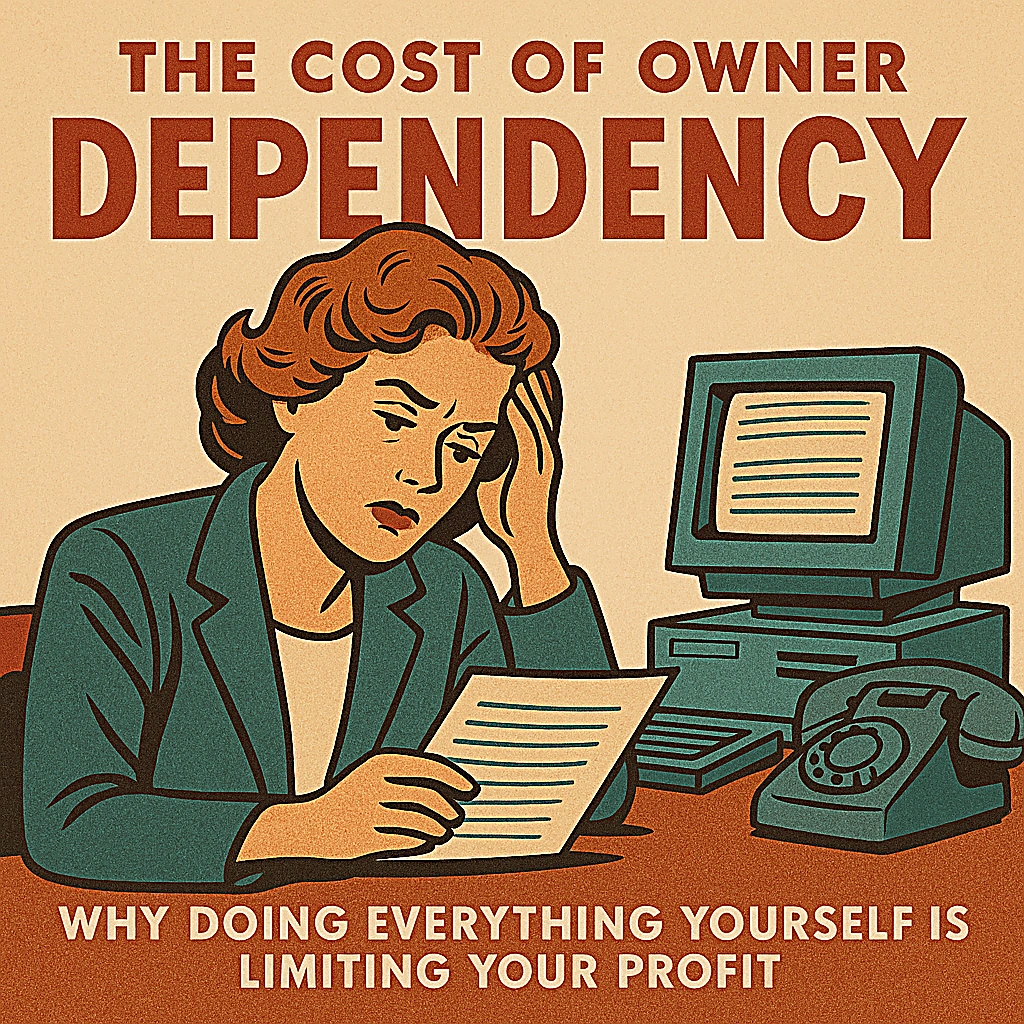
The Cost of Owner Dependency: Why Doing Everything Yourself Is Limiting Your Profit
If your business depends on you, your business can’t grow. Here’s how owner dependency silently destroys profit—and what to do about it.
Most service-based businesses start with the owner doing everything. It’s normal in the early stages. But as the business grows, this becomes a structural liability—one that affects profit, capacity, stress, and long-term sustainability.
Owner dependency in service businesses is one of the biggest (and least discussed) reasons companies plateau. It creates bottlenecks, slows delivery, reduces pricing confidence, and makes it nearly impossible to scale.
This article explains the true cost of doing everything yourself—and how to break free so your business can grow without burning you out.
Why Owner Dependency Happens
Owner dependency rarely happens because owners want control.
It develops because:
-
You know the work better than anyone else
-
Clients expect you personally
-
Delegation feels risky or time-consuming
-
Systems were never documented
-
Processes live in your head
-
Hiring feels uncertain
-
You’re trying to avoid mistakes
-
You can complete tasks faster than team members
-
You don’t want to overwhelm employees
These are understandable reasons—but they produce long-term consequences.
The True Cost of Owner Dependency (Most Owners Underestimate This)
Owner dependency in service businesses is expensive—financially, emotionally, and operationally.
Here’s what it costs:
1. You Become the Bottleneck
Every decision, approval, deliverable, and communication flows through you.
This causes:
-
Delays
-
Rework
-
Missed opportunities
-
Slow project delivery
-
Frustrated clients
-
Stalled sales
You’re not just the owner—you’re the limiter.
2. Capacity Stops Growing
You physically cannot take on more work because you are the limiting resource.
Capacity plateaus because:
-
There’s no one to delegate to
-
You can’t multiply yourself
-
More clients = more stress
-
Work scales faster than systems do
Your time becomes the business’s ceiling.
3. Pricing Power Decreases
Here’s the surprising part:
Owner dependency in service businesses leads to underpricing.
Why?
Because when delivery feels overwhelming or disorganized, you lose confidence in charging more.
You think:
-
“We’re not efficient enough yet.”
-
“I can’t justify raising prices.”
-
“Clients won’t pay more for this experience.”
Pricing improves when systems improve—not when you “try harder.”
4. Burnout Becomes a Real Threat
This is the emotional cost:
-
You work late
-
You feel stretched thin
-
You can’t unplug
-
You don’t trust your team
-
You skip vacations
-
You resent your inbox
Owner dependency turns passion into pressure.
5. The Business Cannot Grow Past a Certain Level
This is the profit ceiling.
No matter how hard you work, you cannot:
-
Increase sales
-
Reduce workload
-
Improve margins
-
Expand your offering
-
Take on more clients
Growth becomes impossible without structural change.
6. The Business Has Low Transferable Value
If you ever want to sell your business, owner dependency is a deal-killer.
Buyers don’t want a business that cannot operate without the owner.
A company dependent on you is:
-
Harder to sell
-
Worth far less
-
Riskier to transfer
Reducing owner dependency increases business value dramatically.
How to Reduce Owner Dependency in Service Businesses
Breaking owner dependency doesn’t require a giant overhaul.
It requires small, strategic changes that allow your business to operate independently.
1. Systemize Repeatable Processes
Start with:
-
Onboarding
-
Delivery workflows
-
Communication templates
-
Project steps
-
Quality checks
Systems turn chaos into consistency.
2. Document the “Right Way” to Do Things
Your business shouldn’t run on tribal knowledge.
Document:
-
SOPs
-
Checklists
-
Templates
-
Scripts
-
Standards
This allows others to succeed without hand-holding.
3. Delegate in Layers, Not All at Once
Think of delegation like building scaffolding:
-
Step 1: Delegate low-risk tasks
-
Step 2: Delegate repeatable tasks
-
Step 3: Delegate defined outcomes
-
Step 4: Delegate decision-making authority
The mistake owners make is jumping from step 1 to step 4 too fast.
4. Use Automation to Replace Repetitive Work
Automation is your first “digital employee.”
Automate:
-
Scheduling
-
Follow-ups
-
Reminders
-
Onboarding tasks
-
Project updates
-
File delivery
-
Client communication sequences
Automation reduces your workload without adding headcount.
5. Build a Leadership Layer
Eventually, you need someone between you and the front line.
This could be:
-
A project manager
-
An operations coordinator
-
A lead technician
-
A client success manager
Your job becomes strategy—not task execution.
6. Strengthen Your Offer and Pricing Structure
Value-based pricing works best when the owner is not the bottleneck.
Improving:
-
Offer clarity
-
Scope boundaries
-
Delivery stages
-
Communication plans
…reduces friction and increases confidence.
How the Profit Lab Score™ Helps Reduce Owner Dependency
Your Score identifies:
-
Where you’re acting as the bottleneck
-
Which processes rely solely on you
-
Where delegation or automation would unlock capacity
-
How your operations create or avoid dependency
-
How much extra profit you could earn by reducing owner dependence
Your Profit Opportunity Index™ shows how much more your business could achieve if owner dependency drops.
Your roadmap includes:
-
Delegation strategies
-
Systems to document
-
Automation opportunities
-
Team structure recommendations
-
Step-by-step instructions to reduce owner workload
-
Prioritized actions to create leverage
It’s the clearest path to escaping owner dependency in service businesses.
Key Takeaway
Owner dependency isn’t a personality flaw.
It’s a structural issue.
And once you fix it:
-
Profit increases
-
Stress decreases
-
Capacity expands
-
Pricing strengthens
-
Delivery improves
-
Growth becomes sustainable
-
Your business becomes far more valuable
The goal isn’t to replace you—it’s to free you.
Ready to Reduce Owner Dependency and Increase Profit?
Take the free Profit Lab Score™ and discover:
-
Where you’re the bottleneck
-
How to remove friction
-
How much profit you’re losing
-
Your Profit Opportunity Index™
-
A personalized roadmap to increase capacity and reduce stress
Join the first 50 business owners on our launch list and receive a free Lite Profitability Roadmap ($295 value).
Recent Comments
Recent Comments
Archives
Categories
Profit Lab Score™ your partner to discover lost profitability in your business!
Copyright © 2026 Profit Lab Score™

Profit Lab Score™ your partner to discover lost profitability in your business!
Copyright © 2026 Profit Lab Score™