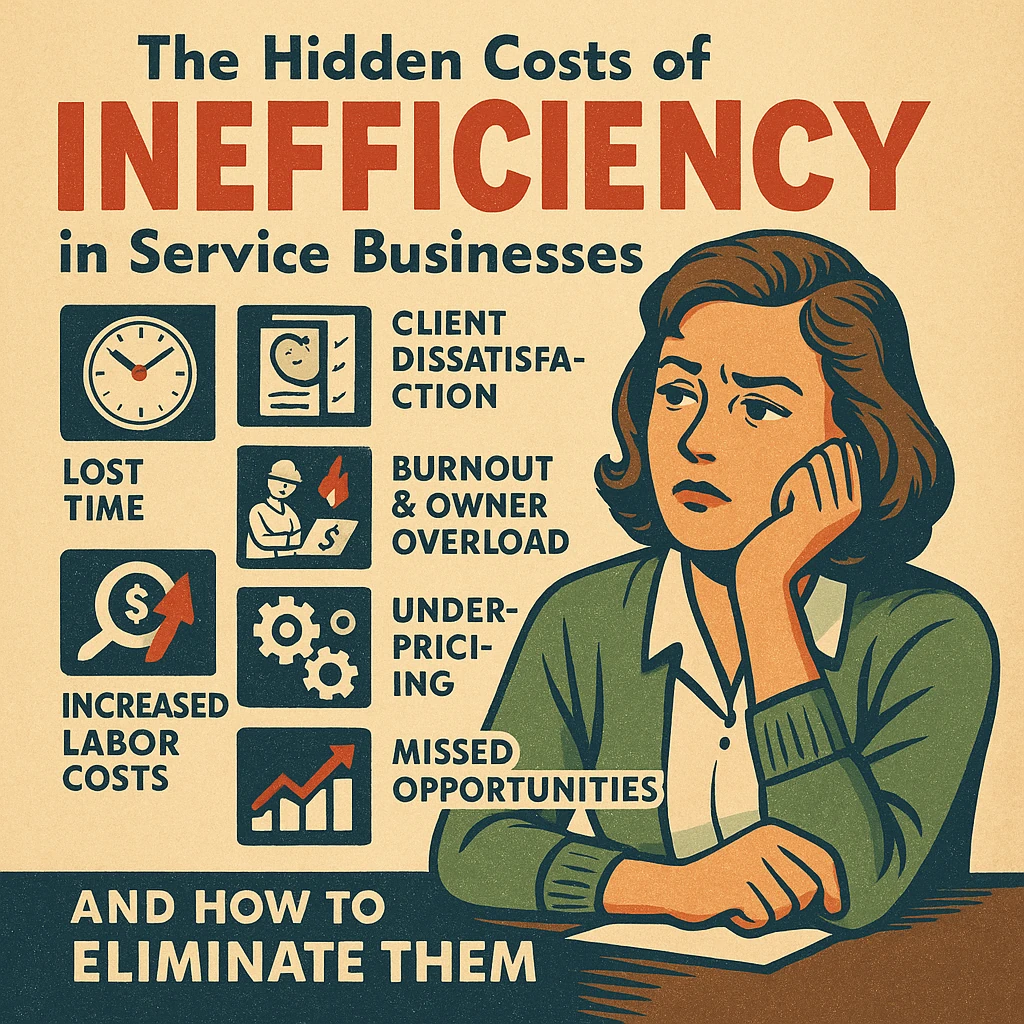
The Hidden Costs of Inefficiency in Service Businesses (And How to Eliminate Them)
Inefficiency doesn’t just slow you down—it silently drains profit, increases stress, and prevents real growth.
Most service businesses don’t lose profit because they lack demand, skill, or ambition.
They lose profit because inefficiencies accumulate quietly over months or years:
-
A few minutes wasted per task
-
Repeated questions from clients
-
Unclear workflows
-
Miscommunications
-
Scope creep
-
Underutilized tools
-
Owner bottlenecks
-
Inconsistent pricing
-
Manual processes no one has time to fix
These small cracks eventually become structural problems.
And by the time they become visible, thousands of dollars have already slipped through.
This article breaks down the hidden costs of service business inefficiency, how to recognize them early, and what you can do to eliminate them.
What Inefficiency Really Means in a Service Business
Inefficiency is more than “working slowly” or “being disorganized.”
It shows up in three distinct ways:
1. Operational Inefficiency
Tasks take longer than they should.
Work gets repeated.
Communication breaks down.
2. Strategic Inefficiency
You focus on activities that don’t actually drive profit.
Opportunities go unnoticed.
Priorities become unclear.
3. Bottleneck Inefficiency
Everything depends on the owner.
Nothing moves unless you touch it.
Your time becomes the limiting factor.
All three silently erode margin, capacity, and growth.
The 7 Hidden Costs of Inefficiency
Most service-business owners underestimate how costly inefficiency really is.
Here’s what it’s costing you—even if it’s not obvious yet.
1. Lost Time (The Most Expensive Cost of All)
Time is your most valuable resource.
When tasks take longer than they should, profitability drops instantly.
Examples include:
-
Rewriting emails
-
Fixing unclear deliverables
-
Chasing client approvals
-
Repeating onboarding instructions
-
Searching for missing files
A few minutes here and there quickly accumulate into hours—and hours into thousands of dollars in lost billable time.
2. Increased Labour Costs
Inefficient systems force you or your team to:
-
Work overtime
-
Handle unnecessary tasks
-
Correct errors
-
Manage chaos instead of delivering work
Labour becomes a cost center instead of a profit center.
3. Client Dissatisfaction
Clients don’t always complain—but they always notice.
Inefficiency creates:
-
Slower delivery
-
More mistakes
-
Confusion around expectations
-
Friction in communication
-
Lower perceived value
Even small operational hiccups can harm retention and referrals.
4. Burnout and Owner Overload
One of the biggest hidden costs of inefficiency is emotional and physical exhaustion.
Symptoms include:
-
Being the only one who knows how to do things
-
Working late just to stay caught up
-
Constantly firefighting
-
Feeling like growth just makes everything worse
Burnout limits capacity—your business will never outgrow your energy.
5. Underpricing Due to Unclear Effort
When delivery isn’t systemized, it’s impossible to estimate or price confidently.
Inefficiency leads to:
-
Undercharging
-
Scope creep
-
Giving away unpaid work
-
Fear of raising prices
This is one of the fastest ways to destroy margin.
6. Reduced Capacity (You Literally Cannot Take On More Work)
Even with strong demand, inefficiency creates a hard ceiling.
You can’t grow because:
-
Delivery takes too long
-
The admin burden expands faster than revenue
-
You become the bottleneck
-
You can’t delegate effectively
Growth becomes a burden instead of an opportunity.
7. Missed Opportunities for Innovation and Improvement
Inefficiency consumes all your bandwidth, leaving no room to:
-
Update offers
-
Strengthen messaging
-
Improve operations
-
Train the team
-
Explore new revenue streams
When your business runs at maximum strain, innovation dies.
Why Inefficiency Is So Common in Service Businesses
Service businesses are uniquely vulnerable to inefficiency because:
-
Every project is slightly different
-
Delivery is often customized
-
Communication is constant
-
The owner plays too many roles
-
Processes are rarely documented
-
Teams rely on “tribal knowledge”
-
Complexity grows faster than systems do
No one chooses inefficiency.
It grows organically over time—until someone evaluates the business holistically.
How to Eliminate Inefficiency (Without Overhauling Your Entire Business)
Efficiency improvements don’t require giant transformations.
Start with small, high-impact changes in these areas:
1. Systemize Repeatable Tasks
If something happens more than twice… it should have a system.
Examples:
-
Client onboarding
-
Proposal creation
-
Project kickoff
-
Status updates
-
File delivery
-
Offboarding
Systems reduce errors and free up bandwidth.
2. Use Automation for Administrative Work
Automation should replace:
-
Appointment scheduling
-
Reminders
-
Follow-ups
-
Document delivery
-
Proposal signatures
-
Invoicing and payment collection
Automation removes repetitive work that drains time.
3. Document Core Processes
Clear, simple SOPs help your team:
-
Follow consistent steps
-
Reduce confusion
-
Eliminate rework
-
Speed up delivery
-
Protect quality
Documentation is a force multiplier.
4. Delegate with Confidence
Most delegation fails due to lack of clarity.
To delegate effectively, define:
-
What success looks like
-
What steps to follow
-
What tools to use
-
What quality checks to apply
The goal isn’t just to “offload work”—it’s to create predictable outcomes.
5. Align Pricing With Delivery Reality
If your processes are inefficient, your pricing model will always feel uncomfortable.
Raising prices often requires:
-
Clarifying your offer
-
Eliminating unnecessary steps
-
Tightening scope boundaries
-
Strengthening value communication
Efficiency and pricing are deeply connected.
How the Profit Lab Score™ Identifies and Quantifies Inefficiency
Your Profit Lab Score™ reveals:
-
Which parts of your operations are inefficient
-
How inefficiency impacts profitability
-
Where your biggest bottlenecks are
-
What changes will unlock the most capacity
-
Which actions will have the fastest ROI
And the Profit Opportunity Index™ shows how much additional profit is available to you once inefficiency is reduced.
Your roadmap then tells you:
-
What to fix
-
How to fix it
-
In what order
-
With what level of effort
-
And what impact you can expect
It turns inefficiency from a vague frustration into a solvable problem.
Key Takeaway
Inefficiency is not a minor inconvenience—it’s one of the biggest silent killers of profit in service businesses.
When you eliminate inefficiency, you:
-
Increase capacity
-
Improve margins
-
Strengthen client experience
-
Reduce owner stress
-
Unlock growth potential
-
Free time to innovate
-
Improve profitability dramatically
Efficiency is not just about doing things faster—it’s about doing the right things in the right way.
Want to Know How Inefficient Your Business Really Is?
Take the free Profit Lab Score™ and get:
-
A breakdown of your inefficiency hotspots
-
Your Profit Opportunity Index™
-
Practical steps to improve efficiency
-
A personalized roadmap
-
Step-by-step actions tailored to your business
Be among the first 50 business owners on our launch list and receive a free Lite Profitability Roadmap ($295 value).
Recent Comments
Recent Comments
Archives
Categories

Profit Lab Score™ your partner to discover lost profitability in your business!
Copyright © 2026 Profit Lab Score™

Profit Lab Score™ your partner to discover lost profitability in your business!
Copyright © 2026 Profit Lab Score™