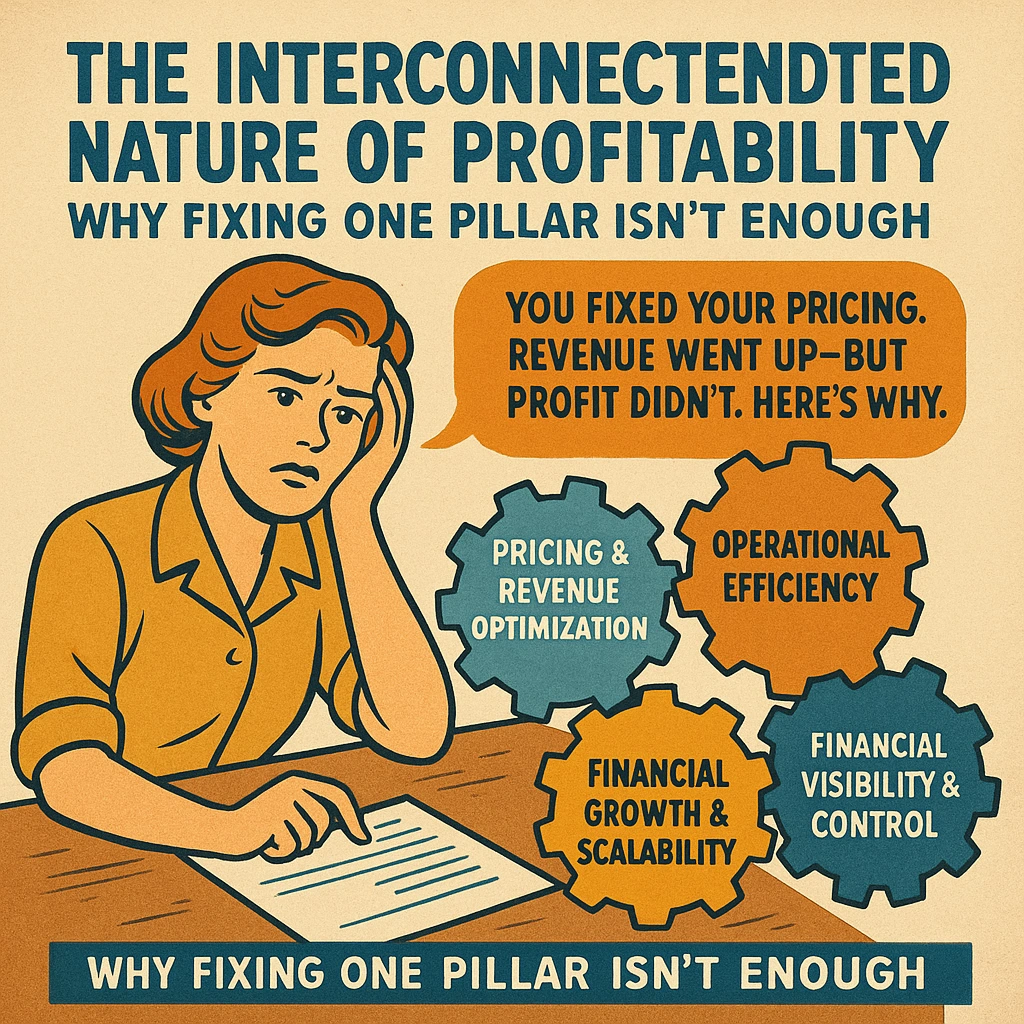
The Interconnected Nature of Profitability: Why Fixing One Pillar Isn’t Enough
You fixed your pricing. Revenue went up—but profit didn’t. Here’s why.
Three months ago, Sarah finally worked up the courage to raise her rates.
She’d been undercharging for years. Everyone told her so—her peers, her mentors, even her clients who kept saying “you should charge more for this.” So she did it. She restructured her consulting packages, increased prices by 30%, and braced for pushback.
It never came. Clients said yes. New proposals closed. Revenue climbed.
But when she looked at her profit margin six months later, it had barely moved.
She’d fixed her pricing problem—so why wasn’t she more profitable?
The Problem with Isolated Fixes
Here’s what most business advice gets wrong: it treats service business profitability like a checklist.
- Raise your prices
- Streamline operations
- Get better clients
- Track your numbers
- Scale strategically
The implication? Fix these things, and profit will follow.
But service business profitability doesn’t work like that. It’s not a list of independent improvements. It’s a system—and in a system, everything affects everything else.
Sarah’s pricing fix failed because while she was charging more, her operations were still a mess. Every project took 40% longer than it should. Scope creep was constant. Her team was drowning in manual work. She was charging premium rates but delivering at discount-level efficiency.
Higher prices couldn’t overcome broken operations.
Why Profitability Is a System, Not a Checklist
Think of your business as a machine with five interconnected gears:
- Pricing & Revenue Optimization
- Operational Efficiency
- Client Acquisition & Retention
- Financial Visibility & Control
- Strategic Growth & Scalability
When all five gears turn smoothly together, profit flows naturally. But when even one gear is broken, it creates drag on the entire system—no matter how well the others are functioning.
Let’s look at how these pillars interact—and why isolated fixes rarely work.
How Weak Operations Sabotage Great Pricing
You raise your rates. Clients agree. Revenue increases.
But if your operations are inefficient, you’re still spending the same amount of time (or more) delivering the work. Your team is still context-switching between projects. You’re still starting every engagement from scratch with no templates or systems.
Result: Higher revenue, same costs, minimal profit improvement.
This is exactly what happened to Sarah. She was charging premium rates for projects that were costing nearly as much to deliver—leaving thin margins. When she raised prices further, her delivery costs increased because her operations couldn’t handle the increased complexity of premium clients.
Her margin? Still minimal.
She fixed pricing but ignored operations. The system stayed broken.
How Poor Client Fit Undermines Efficient Operations
Now let’s say you’ve nailed your operations. You’ve documented processes. Built templates. Streamlined delivery. You can execute projects faster and more profitably than ever.
But if you’re attracting the wrong clients—the ones who don’t fit your service model, who require constant hand-holding, who push back on scope—all that efficiency evaporates.
Result: Great systems, exhausting clients, eroded profit.
A marketing agency we worked with had this exact problem. They’d built an incredibly efficient content production system—optimized workflows, clear deliverables, predictable timelines. On paper, they should have been highly profitable.
But a significant portion of their clients were terrible fits. They wanted custom everything. They didn’t respect boundaries. They generated constant revision requests that fell outside the documented scope.
The agency’s beautiful operational machine was constantly derailed by clients who didn’t value or respect the system.
Efficiency couldn’t overcome poor client selection.
How Lack of Financial Visibility Masks Unprofitable Growth
Here’s a scenario that kills service businesses silently:
You’re growing. Revenue is up 50% year-over-year. You’re hiring. You’re busy. Everything feels like it’s working.
But you don’t have real financial visibility. You’re not tracking profit by service line, by client, or by project. You’re not calculating your true delivery costs. You don’t know which parts of your business are actually making money.
Result: Revenue growth that hides unprofitable services, unsustainable clients, and margin erosion.
One consulting firm came to us celebrating significant revenue growth. When we analyzed their financials, we discovered that two of their three service lines were losing money once all costs were included. They were growing—but growing the wrong things.
Without financial visibility, they couldn’t see that their growth was unprofitable until it was almost too late.
How Unscalable Models Prevent Strategic Growth
Finally, let’s say you’ve optimized everything: great pricing, efficient operations, ideal clients, clear financials.
But your service model is fundamentally unscalable. Everything is custom. Delivery depends entirely on you or a few key people. There’s no leverage, no repeatability, no way to grow without linear increases in cost.
Result: A profitable business that can’t grow—or can only grow by sacrificing margin.
This is the owner-dependency trap. Your business is profitable at its current size because you’re doing the high-value work yourself. But the moment you try to scale—hire more people, take on more clients—your profit margin collapses because no one can replicate your expertise or efficiency.
Profitability without scalability is a dead end.
The Compounding Effect of System-Level Optimization
Now here’s the good news: when you optimize profitability as a system instead of isolated fixes, the results compound.
Let’s return to Sarah.
After her pricing-only approach failed, she took a different path. She used the Profit Lab Score™ diagnostic and discovered her real issue wasn’t just pricing—it was the interaction between pricing, operations, and client fit.
Her 90-day roadmap prioritized three things in sequence:
Weeks 1-4: Operational Foundation
- Documented her core service delivery process
- Created project templates and client onboarding systems
- Eliminated significant duplicated effort each week
Weeks 5-8: Client Qualification
- Built an ideal client profile based on her most profitable engagements
- Implemented a qualification framework for new opportunities
- Politely transitioned two poor-fit clients to other providers
Weeks 9-12: Pricing Refinement
- Restructured her services into three tiered packages
- Added value-based pricing for strategic engagements
- Built scope protection language into all contracts
The result?
- Revenue: Increased substantially (she raised prices again, but this time she could deliver on the promise)
- Delivery costs: Decreased significantly (operational efficiency kicked in)
- Profit margin: More than doubled over six months
She didn’t just fix pricing. She fixed the system. And when the system is optimized, profit doesn’t just improve—it multiplies.
Why Sequence Matters
Here’s the critical insight: not only do all five pillars need to work together, but the order in which you fix them matters enormously.
If Sarah had started with client acquisition before fixing her operations, she would have simply amplified her inefficiency problems. More clients, same chaos, lower margins.
If she’d focused on growth before addressing financial visibility, she might have scaled the wrong services—growing revenue while destroying profit.
The most effective service business profitability improvements follow a strategic sequence based on your specific business. Where are your biggest leaks? Which fixes create the foundation for others? What’s the highest-leverage starting point?
Generic advice can’t answer that. One-size-fits-all checklists can’t answer that.
You need a diagnostic that identifies your unique weaknesses—and a roadmap that sequences the fixes in the right order.
The Difference Between Information and Transformation
Most business advice gives you information about service business profitability. “Here are the five pillars. Good luck!”
But information without a personalized, prioritized action plan is just noise.
What actually drives transformation is this:
- Diagnosis: Understanding which pillars are weak in your specific business
- Prioritization: Knowing which fix to tackle first for maximum impact
- Sequencing: Building improvements in an order that compounds results
- Action: Having a week-by-week roadmap that turns insight into execution
This is exactly what Profit Lab Score™ provides.
The diagnostic doesn’t just tell you “operations need work.” It tells you that operational inefficiency is your #1 profit leak, costing you an estimated $47,000 annually, and that fixing it will unlock improvements in client satisfaction and pricing power.
The roadmap doesn’t just say “improve operations.” It gives you 12 specific, prioritized tasks to complete over the next 90 days—starting with the highest-leverage fixes first.
That’s the difference between knowing what’s wrong and actually fixing it.
The Expected Impact: Why Systems Thinking Matters
Based on established business optimization research and profitability frameworks, we can project the likely outcomes of different approaches:
Addressing a single weakness in isolation typically yields modest improvements—often 3-7% margin gains that may not sustain over time without supporting changes.
Fixing 2-3 interconnected areas creates compounding effects, with research suggesting 12-18% margin improvements are achievable when operational efficiency supports better pricing, for example.
Optimizing all five pillars as an integrated system is where the transformation happens. Business optimization studies consistently show that holistic, sequenced improvements can drive 20-35% margin increases—because each fix amplifies the others.
This is exactly what Profit Lab Score™ is designed to deliver: not isolated advice, but a roadmap that treats your business as the interconnected system it is. As our platform launches and clients complete their 90-day journeys, we’ll be tracking real outcome data to continuously refine and improve the recommendations.
Your Next Step
If you’ve tried to improve service business profitability before and the results didn’t stick, you probably weren’t addressing the system—you were applying isolated fixes.
The Profit Lab Score™ diagnostic is designed to see the whole picture. It evaluates all five pillars, identifies the interactions between them, and generates a personalized roadmap that addresses your business as a system—not a checklist.
Here’s what you’ll discover:
- Your Profit Lab Score™ (0-100): where your profitability systems stand today
- Your Profit Opportunity Index™ (0-100): how much untapped profit is available
- Your weak pillar analysis: which areas are holding you back—and why
- Your 90-day roadmap: a week-by-week plan with specific, sequenced tasks
Stop guessing. Stop applying random fixes and hoping they stick.
Join the first 50 business owners on our launch list and receive a free Lite Profitability Roadmap ($295 value).
Recent Comments
Recent Comments
Archives
Categories

Profit Lab Score™ your partner to discover lost profitability in your business!
Copyright © 2026 Profit Lab Score™

Profit Lab Score™ your partner to discover lost profitability in your business!
Copyright © 2026 Profit Lab Score™